



Use of Photos
Should you wish to download any of these photographs I would be pleased to have them used for personal, educational, or other non-profit purposes. I ask, however, that they not be used for commercial purposes. Note that there are no model releases on any of the images. If you do use them I would ask that you :
1. Use them tastefully. 2. Let me know by email that you are going to use them. 3. Give me credit for the photo ("photo: billhocker.com") with a link to my site where appropriate.

Autobiography
With architecture school finished and the draft board at my heels, I joined the Peace Corps in 1970. From that experience, both travel and photography became important creative interests that would punctuate 12 more years of frustration in the architectural profession. Finally realizing the error of my ways I chose passion over respectability and began ...(photography is really no way to make a living, is it?) ...Wm Hocker Toy Soldiers in 1984. Interest in photography, dormant during the early toy soldier era, has now been rekindled thanks to the development of an accessible audience via the internet.
The Travels & Photographs
These albums now encompass 60 years of photographic passion. Each photo includes the year it was taken: I confess that dating photos is a bit of an obsession. It is frustrating to view the work of others, in whatever field of interest, without being able to place it in a historical context. With the exception of 2 years spent in Tunisia and 2 summers spent on Sardinian archeology, the
photographs have been taken on 1 and 2 week tourist vacations or around my home in the Bay Area. I am a bit more interested in photography than in traveling, and often less is retained from the trips in the way of factual information than in imagery. Should you wish to help me out with locations or names where they are lacking I would be much obliged.
Equipment & Media
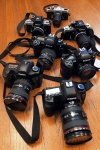
I suspect I'm not the only photographer who's a gear junkie, although my kit is minimal at any one time. Does new tech improve one's photographs? In my case, looking back over the last 60 years, not much. As my vision declined auto-focus was a godsend, and digital is sharper and smoother than film and makes low-light shots possible. But that's about it. Some poo-poo the idea that gear matters; it's the vision that counts. Justly so. Yet there's nothing like a new piece of gear to renew the forlorn hope that it will make me the great photographer I dream of being.
Film Era
Photographs taken before 1973 (Tunisia and some European shots) were made with a Pentax Spotmatic with a 35mm, 105mm and 150mm lenses. With only a couple of exceptions the film used was Ektachrome, 64 ASA. From 1973 to 2001 photographs were taken with 2 Nikon F2's using principally 24, 105 and 200mm lenses. Rarely used, but still in the bag, have been a 35mmPC and a 55mm Micro. At one point, at the height of equipment lust, a 16mm fisheye and 500mm mirror lens were included. In 1994 the 35, 55, and 105 were supplanted by a 35-105 zoom. In 2001, finding manual focusing increasingly difficult, I switched to 2 F100's, a 20mm, a 28-105 and a lightweight 80-200mm. All photos taken with the Nikons have been on Kodachrome, 25 ASA until 1989 and 64 ASA thereafter. No filters other than UV were used and all photos were taken using available light. Some pictures close to home were taken on a tripod, but most all shots beyond the California border are hand-held (or propped on the camera bag).

Industrials 3, Industrials 5 and California 11 are the only albums of photos not taken in 35mm format. The camera is a 4x5 Arca Swiss with Schneider 90, 135 and 210mm lenses. The Film is Ektachrome, 64 ASA. Sadly there is little difference in the quality of 35mm and 4x5 photos when viewed at similar sizes on the internet - it is impossible to convey the awe-inspiring tonality and detail of a color transparency equivalent in area to ten 35mm slides. For a while that difference justified the enormous effort and cost required to take a shot.
Digital Era
In 2005, going to Peru, I took along a small Sony 7MP P200 in addition to the Nikons. I loved the camera and the ease of taking photos in places where I normally wouldn't bother: low light, aerial shots, museum shots, under fluorescent lighting, during performances. I loved the fact that it was silent, had great dof, that I could view shots taken, shoot multiples without waste, show images to friends and subjects, put the camera in my pocket.

In 2006, with a trip to India looming, the time came to go completely digital. I purchased a Nikon D200 with an 18-200mm lens. My one regret was is that the beautiful F100's, barely 6 years old, lay neglected in the closet - yet going back to film is unthinkable.
In 2008 the unaffordable, unportable Nikon D3 finally arrived to conceed the victory of the full frame sensor for serious work. I went to the dark side and bought an affordable Canon 5D and a brace of f4 lenses for a trip to Jordan and Syria. Unfortunately, the 5D was a Neandrathal to work with, a great sensor crippled by poor control and software decisions. I bracket every exposure and constantly monitor focus and exposure settings just as in the old all-manual days, but the quality of the images, when the settings are right and even in the worst lighting conditions, are stunning.
In 2010 the 5D was upgraded to a 5DII for Cambodia. (Nikon still doesn't have an equivalent IQ/weight/cost ratio.) The MkII is an easier camera to use (no more fiddling with the top buttons!) but bracketing and setting-awareness are still necessary as exposure and auto-algorithms remain poor. It was a bit of a disappointment also in its IQ. More noise than the 5D, occuring in very nasty banding or burlap patterns, and much more splotchy color noise (more even than the 5D! The Nikon had none of this color noise).
In 2014 I bought a Canon 6D. Lighter than the 5D's with most buttons under the right thumb (where they should be on all cameras), and much better high ISO noise (without banding!) and most important (since I have become the performance photographer for Mui's chorus), very quiet.
In 2022 I bought a Canon R5 and a couple of RF lenses. I like the higher resolution, though it doesn't really show up in web photos at 1333x2000px. And I like the touch screen. I like the autofocus eye-detect for my concert work. But much that I disliked about the previous Canons (soft jpegs, bad light metering, clumsy image review) remained unchanged. And the bump on the body that dug into my left palm really bugged me. And the lenses are so fat at the mount that I constantly feared dropping the camera for want of a good grip. My complete likes and dislikes of the R5 are here.
In late 2023 I tried a Sony, lent to me by a relative. It was an A7IV with a Tamron 28-200mm lens. Viewing the results of that lens, I immediately purchased the same combo. To find a lens that is crisp at all focal lengths, f-stops and across the entire frame in such a small package (and very fast for a superzoom) was amazing. I had tried a Sony A7rIV before buying the R5 and though being in awe of the IQ, I was turned off by the ergonomics. The A7IV has a slightly deeper grip, so at least my pinky no longer hangs off the end although the grip still feels wooden in the hand. Like the R5, Sony cameras dig into my left palm - nothing I can do about it. But the difference in IQ over the R5 is remarkable. The sharpness has much to do with Sony's better jpeg handling: no more smudgy low contrast detail. Metering on the Sony is much more consistant than any Canon I've had. And the focus tracking is easier to use and much sticker without all the distracting blue squares that jumping around. And best of all it is smallish, whether in my hand or around my neck. The R5 now seems like a tank, and I was self-conscious of that imposing bulk when carrying it. Unfortunately, I don't get rid of cameras so now I have $6000 of almost new Canon gear stuck in the closet. .
All photos shot with digital cameras are large JPEG's. Life is too short for raw files.
Digital Preparation
Film: All of the 35mm scans for this site were done on a Nikon LS4000 slide scanner . 4x5 scans were done on an Epson flatbed with integral transparency unit.
Digital files: The digital files were manipulated on a Macintosh using Photoshop. Manipulating is now done using 3400x5100 pixels scans or camera JPEG then reduced to 2000x3000 pixels. There is a big difference between earlier and later efforts because of improvements in equipment and technique over time, and I slowly continue to upgrade old images.
Viewing and Printing the Photos
During most of the internet age, the appearance of web photos was quite dependent on the characteristics and location of the monitor used. Unfortunately what looked good on my computer often looked terrible on another. But the universal use now of LCD displays, and in particular Retina displays, has made images much more consistant with infinitely better image quality. There are still very noticeable color differences, between my ipad and iphone for example, but they are within an acceptable range. Subject to the abilities of your printer, good quality postcard-sized prints may be made by downloading the images and printing at a 50% (or 30%) reduction. I have now also uploaded most of the original high-resolution images for the photos on the site. Larger prints can be made from them but most will need to be sharpened and many spotted before printing.

Publication
I have been pleased to have some of my photos used in Blue Guide publications over the last few years, especially pleased over the incorporation of numerous photos in Sites of Antiquity by Charles Freeman including the cover!
Also photos have appeared in:
Making Places for People by Christie Coffin and Jenny Young
and Fruits of Eden by Patricia Damery
I must admit that it is a modest commercial showing given the effort put into the photos. But selling them has never been an interest.
The Website
This site has been up since 1999. After years of html coding, a frames/html implementation, a completely javascript implimentation and flirtation with a flash implimentation, I have now constructed the website using the php scripting language (hand-coded) with album and image data stored in a mysql database.
